Solar & batteries · Explainer
Selling surplus solar in Portugal: UPAC rules, the 2026 changes and what you'll earn
Portugal doesn't do net metering. Instead, home solar falls under the self-consumption regime (UPAC). Here's what that means for exported electricity — including the rule changes that took effect on 28 August 2026.
Key takeaways
- Exported solar is only paid if your UPAC is registered, you have a bidirectional meter and an active surplus-sale contract.
- Without a sale contract, exported energy earns nothing and is not credited against later imports.
- Since 28 August 2026 (DL 130/2026), systems up to 800 W are exempt from prior control only if they do not inject into the grid.
- Expect roughly €0.05–0.08/kWh for surplus — far below the €0.17–0.24 you pay for imports.
UPAC in one paragraph
A home solar installation in Portugal is a Unidade de Produção para Autoconsumo (UPAC): a unit producing electricity primarily for your own use. Energy you consume as it's produced reduces your bill directly. Energy that isn't used — legally, anything not consumed within the same 15-minute period — is surplus (excedente) and flows into the grid.
Exporting is not the same as being paid
This catches many newcomers out. If you inject surplus without an active sale arrangement, you receive nothing for it and it is not deducted from the electricity you buy later; the grid operator simply accounts for it. To be paid you need three things:
- The UPAC legalised with the DGEG (Direção-Geral de Energia e Geologia) under the right prior-control procedure.
- A bidirectional meter fitted by E-REDES, so surplus is measured.
- A contract with a supplier (comercializador) or an aggregator (agregador) that buys your surplus. For most households on the mainland, an aggregator is the usual route.
What changed in 2026
Decree-Law 130/2026 of 29 June revised the self-consumption regime. The key points for households, in force since 28 August 2026 (for procedures started after that date):
- The power limit exempt from any prior control rose from 700 W to 800 W — but only for installations that do not inject surplus into the grid.
- If a small system does inject, even below 800 W, a comunicação prévia (prior communication) is required.
- New rules for collective self-consumption and the allowed distance between production and consumption.
- Where a production licence is required, decisions are due within 90 days, with tacit approval if there's no answer.
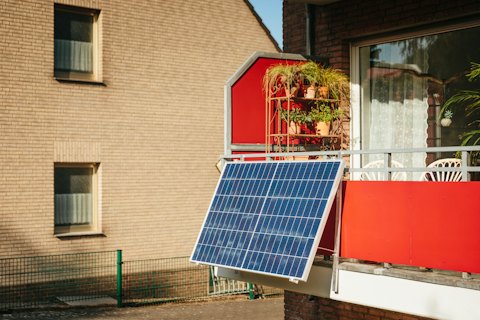
That 800 W threshold matters if you're considering a plug-in balcony solar kit: to stay exempt, it must have zero export — in practice an inverter or controller that limits output to what the house is using.
What surplus is worth
Surplus prices follow the Iberian wholesale market and differ per buyer. Recent Portuguese analyses work with roughly €0.05–0.08 per kWh. Compare that with the regulated-market average of about €0.198/kWh for households in 2026, and free-market offers around €0.22–0.24/kWh: a kWh you use yourself is worth three to four times a kWh you sell.
| Option | Pros | Cons |
|---|---|---|
| No sale contract (zero-export or just accept losses) | No paperwork beyond registration | Surplus earns €0 |
| Aggregator contract | Usually the simplest way for households to get paid | Low price, fees and terms vary — compare |
| Bigger battery instead | Keeps your surplus for the evening | High upfront cost; see our battery guide |
Sizing advice that follows from this
- Size for your daytime load first; treat surplus income as a small bonus, not the business case.
- Move flexible loads into sunny hours: water heater, pool pump, dishwasher, EV/PHEV charging. Home automation makes this effortless — see energy monitoring with Home Assistant.
- If you have a holiday home that's empty much of the year, a small system with a sale contract — or none at all — may beat a large one.
Frequently asked questions
Does Portugal have net metering?
No. Portugal uses a self-consumption model: what you use saves you the retail price, and surplus is sold separately at a market-based price if you have a contract.
Do I need permission for an 800 W balcony kit?
Since 28 August 2026, a system up to 800 W is exempt from prior control only if it does not inject into the grid. If it can export, you need a prior communication.
Who buys my surplus?
A supplier or aggregator you contract with — not E-REDES. Compare offers the same way you compare electricity tariffs.
Sources
- Posso vender o excedente dos painéis solares? (regras 2026) — Doutor Finanças (accessed 29 October 2026)
- Novo regime do autoconsumo de energia: o que muda — Doutor Finanças (accessed 29 October 2026)
- Venda de energia solar em Portugal: guia completo 2026 — Repsol Portugal (accessed 29 October 2026)
- Tarifa regulada de eletricidade 2026 — Repsol Portugal (accessed 29 October 2026)
Keep reading
 Solar
Balcony solar in Portugal: the 800 W rule, zero-export and which kits make sense
Plug-in balcony solar in Portugal after DL 130/2026: when an 800 W kit needs no paperwork, why zero-export matters, realistic savings, and what to look for in a kit or battery.
 Solar
Is a home battery worth it in Portugal? 5 kWh vs 10 kWh, payback and backup
When a home battery pays off with Portuguese tariffs and low export prices, how to choose between 5 kWh and 10 kWh, and what to check about backup during power cuts.
 Solar
Solar panels in Portugal (2026): real costs, savings and payback for expats
What a home solar system costs in Portugal in 2026, how much it saves, why 23% VAT and low export prices change the maths, and how to size it so it pays back.